B
U
S
R
N
/
I
A
E
P
L
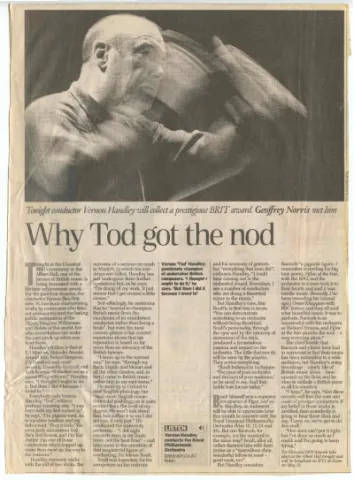
ng/?t conductor Vernon Handley will collect a prestigious BRI'T award. Geoffrey Norvis met bim
Why Tod got the nod
{onight at the Classical
BRITs ceremony in the
Albert Hall, one of the
heroes of British music is
being honoured with a
lifetime achievement award.
For the past four decades, the
conductor Vernon Handley,
now 76, has been championing
works by composers who have
not perhaps enjoyed the lasting
public recognition of the
Elgars, Vaughan Williamses
and Holsts of this world, but
who nevertheless can make
the ears prick up when you
hear them.
Handley’s milieu is that of
E J Moeran, Malcolm Arnold,
Arnold Bax, Robert Simpson,
CV Stanford and, msost
recently, Granville Bantock and
York Bowen. “It started out as a
moral thing with me,” Handley
says. “I thought I ought to do
it. But then I did it because I
loved to.”
Everybody calls Vernon
Handley “Tod”, without
perhaps knowing why. “I was
born with my feet turned in”,
he says. “I'm pigeon-toed. So
is my elder brother, and my
father said, ‘They toddle.” We
were both nicknamed Tod.
He’s Tod Senior, and I'm Tod
Junior. I'm one of those
conductors who's tripped up
more than most on the way to
the rostrum.”
Handley currently walks
with the aid of two sticks, the
outcome of a serious car crash
in Munich, in which his taxi-
Vernon ‘Tod’ Handley:
just undergone three further
operations, but, as he says,
“I'm doing all my work. It just
means that I get around a little
slower.”
Self-effacingly, he maintains
that he “wanted to champion
British music from the
standpoint of an established
conductor, rather than being a
freak”, but even the most
cursory glance at his concert
repertoire shows that his
reputation is based on far
more than an advocacy of the
composers. 'l thought |
ought to do it,” he
says. ‘But then | did it
because | loved to'
driver was killed. Handley has
passionate champion
of underrated British
British byways.
“I came up in the normal
way,” he says, “through my
Bach, Haydn and Mozart and
all the other classics, and, in
fact, I came to British music
rather late, in my mid-teens.”
He went up to Oxford to
read English philology, but
“read more English music
than I did philology, as is quite
evident from the level of my
degree. We won't talk about
that, but suffice it to say I did
get one, if only just.” He
conducted the university
orchestra - “I did eight
concerts even in my finals
term: not the best time” - and
later came to the attention of
that magisterial figure of
conducting, Sir Adrian Boult.
Boult was legendary for his
composure on the rostrum
fLISTEN
Vernon Handley
BIE))
conducts the Royal
telegraph.co.uk/
listen
and his economy of gesture,
but “everything that man did”,
enthuses Haniey, “I could
hear coming out in the
orchestral sound. Nowadays, I
see a number of conductors
who are doing a theatrical
mime to the music.”
But Handley’s view, like
Boult’s, is that less is more.
“You can demonstrate
something to an orchestra
without being theatrical.
Boult’s personality, through
the eyes and by the intensity of
movement of the stick,
produced a tremendous
passion and impact on the
orchestra. The little that you do
will be seen by the players.
They notice everything.
“Boult believed in technique
— ‘The eyes of your orchestra
and the ears of your audience,’
as he used to say. And that
holds true for me today.”
Bantock “a gigantic figure. I
remember recording his big
tone poem, Fifine at the Fair,
with the RPO, and the
orchestra to a man took it to
their hearts and said it was
terrific music. Recently, I've
been recording his [choral
epic] Omar Khayyam with
BBC forces, and they all said
what beautiful music it was to
perform. Bantock is as
resourceful with the orchestra
as Richard Strauss, and Fifine
at the Fair plumbs the soul - a
very worrying piece.”
The chief hurdle that
Bantock and others have had
to surmount is that their music
has been unfamiliar to a wide
audience, but Handley’s many
recordings — nearly 100 of
British music alone - have
opened up the field, and he
aims to include a British piece
in all his concerts.
“I hope”, he says, “that those
oult himself was a supreme records will find the ears and
interpreter of Elgar, and so (;souls uf younger conductors. If
my belief in these works is
is Handley, as audiences
will be able to appreciate later
justified, then somebody is
this month in concerts with the going to hear those discs and
Royal Liverpool Philharmonic
say, ‘Come on, we've got to do
this stuff.’
Orchestra (May 16, 17, 24 and
26). But can Bantock, for
“One man can’t put it right,
but I've done as much as I
example, cut the mustard in
could, and I'm going to keep
the same way? Boult, after all,
rather damned him with faint
trying.”
praise as a “marvellous chap,
The Classical BRIT Awards take
wonderful fellow to meet —
place at the Albert Hall tonight and
good cook, too”.
will be broadcast on ITV1 at 11pm
on May 13.
But Handley considers
i
|
@