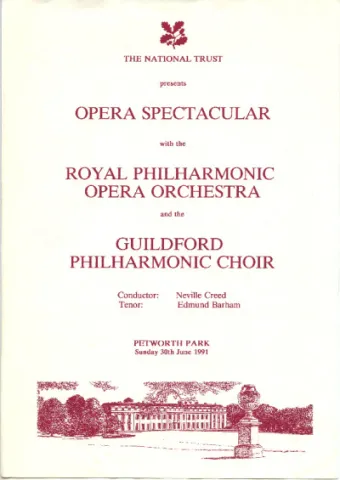
THE NATIONAL TRUST
presents
OPERA SPECTACULAR
with the
ROYAL PHILHARMONIC
OPERA ORCHESTRA
and the
GUILDFORD
PHILHARMONIC CHOIR
Conductor;
Tenor:
Neville Creed
Edmund Barham
PROGRAMME
OVERTURE to WILLIAM TELL
Gioacchino Antonio Rossini (1792-1868)
Allegro vivace
William Tell was Rossini’s last opera before he took early retirement from composition at the age of 38. It is based
on the story by Schiller and unusually for Rossini the overture provides an introduction to the action of the opera.
The rousing allegro finale is used in the opera to symbolize the triumph of the Swiss people over their oppressors.
CHORUS OF THE HEBREW SLAVES from NABUCCO
Giuseppe Verdi (1813-1901)
Nabucco was the first of Verdi’s operatic successes. The opera deals with the plight of the Jews following their defeat
at the hands of Nebuchadnezzar, King of Babylon. In this chorus from Act III, the captive Jews recall their homeland.
Among the Italian audiences the chorus soon became associated with their own patriotism and fight against Austrian
domination. The melodic fervour of unison voices, bursting into harmony at the third verse helped to make this almost
a second national anthem for Italians and one of the world’s great hymns to liberty.
EXTRACTS from CARMEN
Aragonais
Intermezzo
Georges Bizet (1838-1875) .
Danse Bohéme
Flower Song
Toreador Chorus
Carmen has become, as Tchaikovsky predicted, the most popular opera in the world, even though the French public
were initially shocked by it and it was a failure at its first performance. In the opera, Don José is torn between two
women; the gentle and devoted Micaela, and the promiscuous and alluring Carmen whom he loves with a passion
he cannot control. When she deserts him for the bullfighter the struggle destroys him. The Aragonaise leads in to
Act IV, suggesting the teeming activity in a square in Seville where the tragedy will reach its climax. The Intermezzo
introduces the rustic tranquility of the smugglers’ camp in the mountains at the start of Act III. Danse Bohéme is an
arrangement of the gypsy dance at the beginning of Act II in Lillas Pastias’ Inn.
Don José sings the Flower Song
when he meets Carmen in Act II; while Carmen mocks his love he falls at her feet admitting his passion and shows
her, as a sign of his love, the flower she had thrown at him when they last met. The Toreador Chorus is sung by the
crowd gathered outside the bullring to see the procession of bullfight assistants and the Torero Escamillo with Carmen
at his side.
RECONDITA ARMONIA from TOSCA
Giacomo Puccini (1858-1914)
In Act I of Tosca Cavaradossi is at work on a painting of Mary Magdalene.
The painting bears an unmistakable
resemblance to a beautiful young woman who has been visiting the chapel to prepare a hiding place for her brother
who is an escaped prisoner. Cavaradossi compares her features with those of his beloved Tosca in the aria Recondita
armonia de bellezze - ‘mysterious harmony of contrasting beauties’.
GRAND MARCH from AIDA
Giuseppe Verdi (1813-1901)
The Grand March opens Act II, Scene 2 of Aida where, at the gates of Thebes, King and people await the arrival
of the victorious Radames who has defeated the Ethiopians. The people salute their hero in song and dance. At the
first performance in Cairo in 1871 this scene boasted all the exotic delights of Egypt - Arab trumpeters, native military
band and hundreds of singers and dancers.
INTERVAL
(30 minutes)
OVERTURE to THE BARBER OF SEVILLE
Gioacchino Antonio Rossini (1792-1868)
The Barber of Seville, Rossini’s most celebrated opera, was written at
a particularly busy time in his life and was
completed in less than three weeks. In the chaos Rossini apparently lost the original
overture which was said to be
based on popular Spanish themes and he quickly touched up one he had written for
Aureliano in Palmira some years
carlier. After an imposing introduction to still a chattering audience the
music proceeds with bouncing humour and
dry wit.
E LUCEVAN LE STELLE from TOSCA
Giacomo Puccini (1858-1914)
By Act III of Tosca Cavaradossi is awaiting his execution having been
arrested by the jealous chief of police - Scarpia.
He writes a farewell letter to Tosca and recalls his happy memories and dwells on
his despair at separation in the aria
E lucevan le stelle ed olezzava la terra - ‘when the stars were brightly shining
and faint perfumes pervaded the air’.
ANVIL CHORUS from IL TROVATORE
Giuseppe Verdi (1813-1901)
Although the libretto of Il Trovatore is considered by some to be absurd, the
opera itself has had worldwide
popularity. The hero Maurico, the son of a count, is brought up as a gypsy and
in this scene he is at the encampment
with Azucena, the woman who abducted him in revenge for her mother’s death. She
has brought him up as her son
always with the thought that through him she might wreak vengeance upon his kindred.
The gypsy chorus greets the
dawn accompanied by hammering on their anvils.
LA DONNA E MOBILE from RIGOLETTO
Giuseppe Verdi (1813-1901)
Rigoletto is based on Victor Hugo’s play La Roi s’amuse. The censors were not amused
and changes had to be made.
In particular, the wicked hero Frangois I of France in the play became the Duke
of Mantua in the opera. The story
is as follows: the Duke has seduced Rigoletto’s daughter and revenge is planned.
Rigoletto hires an assassin to kill
the Duke, who is lured to a tavern where he has been promised a night of pleasure. The Duke
orders some wine and
sings his famous aria La donna & mobile - ‘women are fickle’. The assassin is persuaded
not to kill the Duke but a
stranger instead and the opera ends tragically as the stranger turns out to be Rigoletto’s
own daughter.
PRELUDE to ACT 3 of LOHENGRIN
Richard Wagner (1813-1883)
The vigorous marching rhythms and brazen quality of Wagner’s Prelude to Act III
of Lohengrin provides a splendid
backdrop for the bustling activity of wedding preparations. In the opera, the Prelude is followed
by the famous Bridal
Chorus which celebrates the union of Elsa and Lohengrin.
NESSUN DORMA from TURANDOT
Giacomo Puccini (1858-1914)
Turandot is based on an ancient fairy tale about a cruel Princess who slays those who love
her unless they can answer
three riddles. One suitor, Calaf, manages to solve them but he says that he is prepared
to die if she can discover his
name. Turandot commands that no one shall sleep until the name is revealed. Calaf,
confident that it will remain
a secret and that he will win the hand of Turandot, sings the famous aria Nessun
dorma - ‘none shall sleep’. Turandot
eventually learns the meaning of true love, and in jubilation the people cry out
O Sole! Vita! Eternita! - ‘O Sun! Life!
Eternity!’
POLOVTSIAN DANCES from PRINCE IGOR
Alexander Borodin (1833-1887)
Borodin began working on his opera Prince Igor in 1869 but it was left incomplete at his
death in 1887 and RimskyKorsakov orchestrated it for its first performance. The Polovtsian Dances form
the colourful and exhilarating finale
to Act II which is set in the camp of Khan Konchak. The Khan has defeated
Prince Igor who is held prisoner.
Because of the Prince’s bravery however, he is treated as an honoured guest rather than
a captive, and entertained
with the spectacular Polovtsian Dances. They are danced by Konchak’s slaves and range from
the sensually enticing
to the barbarously savage.
'
©Programme notes by Neville Creed
THE ROYAL PHILHARMONIC OPERA ORCHESTRA
The Royal Phitharmonic Opera Orchestra was formed as a direct result of the growing demand for a high quality
orchestra to perform opera and ballet music to an ever-increasing, appreciative audience. Shortly after its formation,
the orchestra received invitations to participate in such prestigious events as the Nile Festival and the London
International Opera Festival. Since then, there have been numerous appearances at major venues such as the Royal
Albert Hall and the Royal Festival Hall, in performances of ‘Turandot’, and the perennially popular ‘Opera
Spectacular’. Recent highlights have included concerts with José Carreras and Montserrat Caballe. Future plans
include tours in Europe and the Far East.
THE GUILDFORD PHILHARMONIC CHOIR
The Guildford Philharmonic Choir was formed in order to perform the major choral repertoire with the Guildford
Philharmonic Orchestra. As well as performing well-known choral works, the choir specializes in 20th century British
music and this has led to recordings of Gerald Finzi’s ‘Intimations of Immortality’ with the Guildford Philharmonic
Orchestra and Patrick Hadley’s ‘The Trees So High’ with the Philharmonia Orchestra. The choir is conducted by some
of the most eminent British Musicians including Sir Charles Groves (Principal Conductor), Vernon Handley and Sir
David Willcocks. As well as giving frequent concerts in Guildford, the choir occasionally visits other British cities.
In 1988 the Choir visited Paris and last year joined forces with the Freiburger Bach Choir in Freiburg Miinster.
NEVILLE CREED - Conductor
Neville Creed began his conducting career whilst a choral scholar at Trinity College, Cambridge. He then became
Director of Choral Music at Tiffin School in Kingston-upon-Thames, providing choirs for several highly acclaimed
recordings on radio, television and disc. The Tiffin Boys’ Choir recording of Mahler’s 8th Symphony with The London
Philharmonic under Klaus Tennstedt gained a nomination for a ‘Grammy’ award. In 1986 he was awarded a
scholarship to study at the Guildhall School of Music where he won the Ricordi Conducting Prize. Whilst at the
Guildhall he conducted the second British staging of the opera ‘Julietta’ by Martinu. Since completing his studies he
has founded the London Musici Singers, been appointed Conductor of the Bournemouth Symphony Chorus and
Guildhall Philharmonic Choir, as well as being invited to return to the Guildhall to conduct. In 1988 he won the
second prize in the First International Choral Conducting Competition held in Italy. Last summer he conducted the
European Community Chamber Orchestra in France and he regularly conducts in Denmark. He has given several
concerts with the Royal Philharmonic Pops Orchestra in Petworth Park and at the Exeter Festival.
EDMUND BARHAM - Tenor
Edmund Barham studied at Trinity College of Music, London and the London Opera Centre. Beginning his
professional singing career in Wuppertal, he sang the leading roles in the lyric tenor repertoire. Moving on to Munich
he became a member of the company of the Theater am Gartnerplatz. He has sung leading tenor roles in a number
of major German Opera Houses and in 1985 sang Jenik in a new production of Smetana’s ‘The Bartered Bride’ at the
English National Opera. He returned to the English National Opera in 1986 to sing Turiddu in a new production of
Mascagni’s ‘Cavalleria Rusticana’ and since then he has taken an extremely wide range of parts for the company.
Other recent engagements include Verdi’s ‘Il Trovatore’ in Switzerland, the overseas premiere of Howard Blake’s
‘Benedictus’ in Norway, the ‘Gounod Grande Messe Solonelle’ for BBC Television and a recording of the Rossini
‘Petite Messe Solonelle’ with the City of Birmingham Symphony Orchestra.
Future engagements include a new
production of Verdi’s ‘Don Carlos’ for English National Opera, Don Jose in Bizet’s ‘Carmen’ for the Bregenz Festival
and Pinkerton in Puccini’s ‘Madam Butterfly’ for Welsh National Opera.
¥ ok ok ook
K
The National Trust would like to extend a special invitation to people at this event to enjoy a free visit to this or any
other NT property in Surrey, Hampshire, West Sussex or the Isle of Wight during normal opening hours.
SPECIAL OFFER VOUCHER
This voucher permits free entry for one person, when
FHE NATONAE TRESS
GA A{{DE N[\S)
Y E[}X i’{ ’@i
TWO FOR THE PRICE
OF ONE VOUCHER
accompanied by another paying adult, to all National
Trust houses and gardens in the Southern Region.
This voucher may not be used in conjunction with
any other offer.
This offer is valid until October 31, 1991,
during
normal
advertised
opening
EXCEPT ON BANK HOLIDAYS.
hours,